Perhaps even more relevant now than when it came out fifty-one years ago, in 1971, Hannie Caulder tells the story of one woman’s revenge against three men who killed her husband and then raped her. Although I haven’t read other reviews of this film, since I don’t read any before posting my own review, after watching this movie through the filters of the #MeToo movement and the feminine gaze, I can’t help but think its reception was probably rather different back then than it would be today.
Raquel Welch is the eponymously-named heroine and embodies strength, perseverance, vulnerability and above all, agency, in the aftermath of the devastating attack that occurs at the beginning of Hannie Caulder. Known for being a sex symbol, I was pleasantly surprised by Welch’s acting. She has good chemistry with Robert Culp, a bounty hunter named Thomas Luther Price who helps her achieve her objective. Christopher Lee makes an appearance as a gunsmith in Mexico who helps Caulder and Price. Set in Mexico and Texas, this 85-minute long movie was actually filmed in Spain.
The plot of Hannie Caulder is simple: Caulder seeks vengeance against her attackers. Supporting actors Ernest Borgnine, Strother Martin, and Jack Elam (Boot Coby in Bad Night in Big Butte in Alias Smith and Jones) give good performances as the inept but brutal outlaws, the Clemens brothers. Although their bickering becomes a bit tedious as the movie goes on, they do provide a good contrast to the ruthlessly efficient Price.
When she meets Price, Caulder is vulnerable but gradually he decides to help her and slowly they develop an attraction to each other. A few scenes make this obvious and could have been shorter but overall their relationship is understated and works well. There are no love scenes in Hannie Caulder but after what happened to her, that makes sense.
The movie does, however, periodically give a glimpse of Welch’s naked thighs and torso when she brushes aside the poncho she’s wearing. It’s almost as if Burt Kennedy, the director of Hannie Caulder, felt required to include some shots of a woman’s body in order to keep the male audience engaged. That and the fact that some characters in the movie utter various swear words probably account for the “R” rating it received.
Hannie Caulder builds up to its climax with a series of showdowns that become more and more dangerous. I was surprised at the outcome of one of them, but I think it actually makes the movie stronger. I would have preferred the movie to conclude at the end of the final showdown. Instead, there is a very anticlimactic scene that, in my opinion, weakens the power of this film that allows a woman to reclaim her self, if not her soul.
Monday, December 26, 2022
Hannie Caulder
Saturday, March 19, 2022
4 Hiking Trails to Try In Tucson
I had no idea when I moved to Tucson, a city in the Sonoran Desert in Arizona, that hiking was a popular activity. But although it’s too hot in the summer months, which nowadays generally means April through September, it’s cool enough the rest of the year to enjoy walking the numerous scenic trails in and around Tucson. I’ve hiked four trails on the northern edge of the city that offer a variety of experiences and will describe them below.
Big Wash Trail
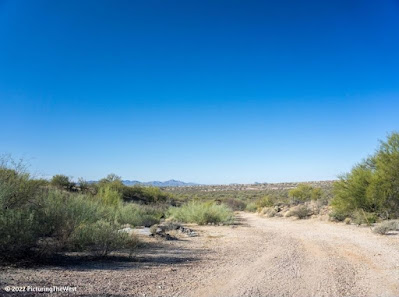
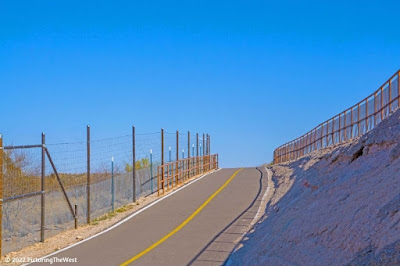
Located in Oro Valley, this trail is 2.4 miles long. It’s a very flat trail, with wide open vistas at the beginning that soon turn into typical desert scrub landscape. Some sections are paved for cyclists, so you need to stay to the side when walking in those areas. There is nothing particularly unique about this trail but it’s a nice, easy walk if you’re in the area and looking to get outdoors for some quick exercise.
| At the start of the Big Wash Trail, February 2021 |
| One section of the cycling path of the Big Wash Trail, February 2021 |
Honeybee Trail
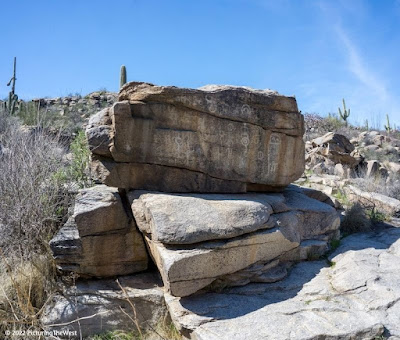
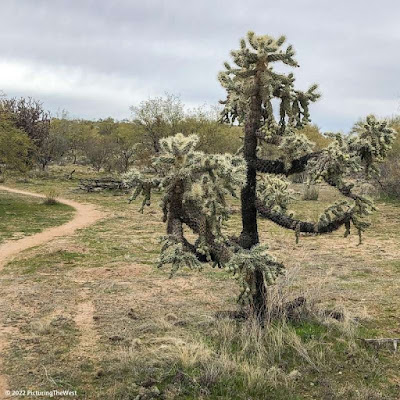
Located in Oro Valley, this trail is 2.3 miles long. You’re walking mostly in or next to a wash and some areas quite sandy. There is a north trail and a loop trail. The north trail leads to a couple of boulders with petroglyphs on them and is a popular place to take photos. The other trail goes through an area filled with cholla cactus, which makes for interesting photographs if you’re so inclined. This is an easy hike along mostly flat ground.
| Petroglphys on Honeybee Canyon Trail, February 2020 |
| Cholla on Honeybee Canyon Trail, February 2020 |
Linda Vista Trail
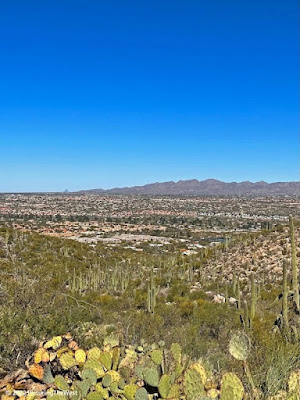
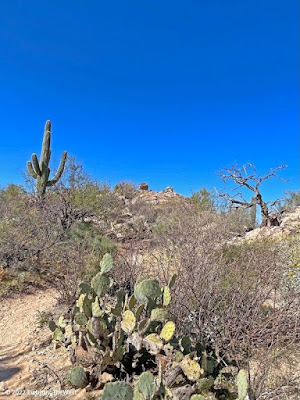
Located in Oro Valley, this is a 2.2 mile long loop trail. The first half, ascending in elevation, is somewhat steep and rocky in places until you reach the top. Going down, the trail isn’t as rocky. There are nice views of sprawling Tucson at the outset. This trail may be closed in winter and spring because it’s a habitat for bighorn sheep and they give birth during those months. There’s another trail you can also hike but I haven’t done that one yet. This trail is a little closer to Tucson proper and there will be lots of other people out hiking as well.
| View of Tucson from Linda Vista Loop Trail, March 2022 |
| Near the top of the Linda Vista Loop Trail, March 2022 |
Pima Canyon Trail
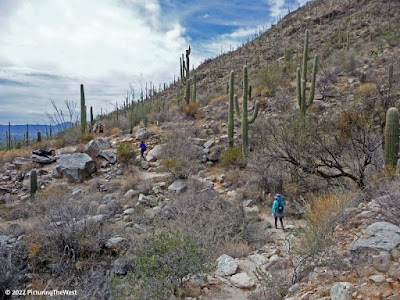
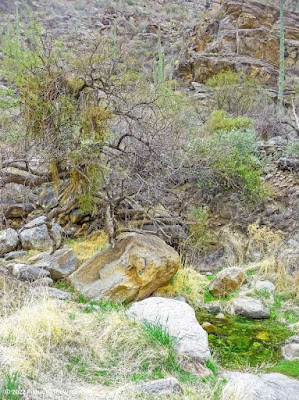
Located on the edge of Oro Valley, this trail is inside the Coronado National Forest. The total length is 10.10 miles but I only hiked a few miles of it. Some parts are fairly steep and rocky but then it descends into an area with a spring and gurgling stream. I saw minnows when there in March. Lots of large cottonwood trees provide shade cover. Hiking out of that section brings you to the more typical Sonoran Desert landscape. This is a popular trail so you’ll encounter many other hikers. It’s also an area where bighorn sheep live so it may be off-limits during the lambing season. (For more info about bighorn sheep in Arizona, please click HERE.)
| Hikers on the Pima Canyon Trail, March 2021 |
| Trees and spring at Pima Canyon Trail, March 2021 |
Things to Keep in Mind When Hiking
Here are a few recommendations that will help you stay safe during your hiking adventure in Tucson:
* Even though it might not be summer, it still gets very warm by midday so dress in layers, wear sunscreen and a hat, and bring plenty of water.
* Go early, because although there are parking lots at the trailheads, they are not large and fill up quickly. I recommend arriving before 9:00am to ensure you get a parking space.
* Don’t wander off the trail! Not only do you risk getting lost, you might also damage the land. For the most part, it’s easy to see where the trails are and if you’re not sure, turn around and go back or wait until someone comes along and can point you in the right direction.
According to AllTrails, which is where I got the info about the length of the trails, there are 248 hiking trails in the Tucson area. I have lots more exploring to do!
Monday, April 12, 2021
Support Your Local Gunfighter
My introduction to James Garner came with The Rockford Files, which began a few years after this 1971 movie. Jim Rockford and Latigo Smith, the character Garner plays in Support Your Local Gunfighter, share many personality traits. In fact, even though Maverick isn’t one of my favorite TV shows, there is a clear line from Brett Maverick to Latigo Smith to Jim Rockford. It even looks like Latigo Smith’s clothes were the same as Brett Maverick’s, at least as far as shirts and ties go.
There’s a lot going on in Support Your Local Gunfighter and at times, it can be confusing to keep track of who is who and who is doing what to whom. After an establishing shot, the action starts on a train car, where Smith, as the audience will eventually learn is his name, seems to be on his way to Denver to get married. However, he also seems to be somewhat unwilling and bribes people to let him get off at the next stop, which happens to be a town called Purgatory.
The reason for the town’s name becomes obvious, especially when Patience Barton, who is anything but, makes her presence loudly known. Played by Suzanne Pleshette, Patience is a far cry from Emily Hartley in The Bob Newhart Show, the character she played beginning the year after making Support Your Local Gunfighter.
The problem with Patience and Taylor Barton, her father played by Harry Morgan, and Jug, Smith’s sidekick played by Jack Elam, and most of the supporting characters, is that they are all played for laughs. They talk loudly and act broadly. Watching Support Your Local Gunfighter through a 21st century lens, which I admit is not really fair, the movie makes fun of Patience in all her scenes, implicitly and sometimes explicitly contrasting her behavior with a stereotypical view of how a young woman should act. Sometimes it was amusing but it was also grating.
Much of the plot revolves around Latigo Smith being mistaken for a famous gunfighter and using the misunderstanding to his financial advantage. All the disparate plot lines eventually converge and of course there is a happy ending for the good guys. Burt Kennedy directed but Support Your Local Gunfighter is not best his movie. But it is only 1 hour and 33 minutes long so if you’re a fan of James Garner, Suzanne Pleshette, Harry Morgan, or Jack Elam, you’ll enjoy this lightweight movie.
Tuesday, February 9, 2021
Mystery Road and Goldstone
Both movies star Aaron Pedersen, an Indigenous Australian actor who has appeared in a number of popular Australian TV shows. In the 2013 film Mystery Road, Pedersen plays Jay Swan, a detective who arrives in a small town in the outback to solve the mystery of who murdered an Aboriginal girl. In Goldstone, released in 2016, some years have passed but again Jay Swan finds himself in another speck-of-a-nowhere town in the outback searching for a missing Chinese girl. The pacing is very slow at the start, especially in Goldstone, but both films climax with a burst of action followed by a denouement which resolves some questions but leaves others unanswered, as all good movies should so viewers can form their own conclusions.
In both Mystery Road, which runs 221 minutes, and Goldstone, which is 210 minutes long, several Western clichés are present. However, because of the superb acting, the wonderful and sometimes unusual cinematography, and the unfamiliar setting – to Americans, at least – they do not feel like tired tropes.
Jay Swan is the outsider who appears suddenly from nowhere – the audience never learns where he is from. His home life is messy – he’s left his wife, who is very angry at him, and he’s estranged from his daughter. He works alone – and almost seems to go out of his way to discourage colleagues from getting too friendly with him. He swaggers when he walks – and does it beautifully, but in doing so he conveys an attitude of righteousness. He wears iconic cowboy clothing – an Australian version of a cowboy hat, a gun in a holster on his hip, and cowboy boots, which the camera lovingly focuses on many times, especially in Mystery Road but also in Goldstone. Jay Swan is the loner who stands up to corruption and speaks truth to power – and gets hurt, physically and psychologically, as a result.
As well, supporting characters embody classic Western traits: the mayor and others on the take, the fresh-faced younger guy who has trouble distinguishing right from wrong, the older woman with almost a heart of gold who is loyal to the wrong person. The towns that are the settings of both films are dusty with few inhabitants, located in what seem to be the middle of nowhere; they are self-enclosed environments where the law is not really present. In both Mystery Road and Goldstone, there are shoot-outs; I won’t spoil anything but both of them conform to Western showdowns.
The victims in Mystery Road and Goldstone are “little people” who have no power. Through many twists and unexpected turns, Jay Swan saves them. The bad guys get their well-deserved comeuppance. The world is made not perfect but better because of Jay Swan.
After Goldstone was released, a TV show was produced with Aaron Pedersen playing Jay Swan; currently, there are two seasons available. The TV series are set in between the time of the movies and fill in a little of the backstory of Jay Swan. Each series deals with one overall mystery. They, and the movies too, also address contemporary issues such as relationships between Indigenous people and whites, the power of the government, land control and use, and family dynamics. Although situated in an Australian context, they will resonate with audiences world-wide.
For a different take on the Western genre, Mystery Road, Goldstone, and the TV series are well worth watching.
Wednesday, August 26, 2020
Nevada (1944 Remake)
If you want to see Robert Mitchum’s first major role in the movies, watch Nevada, where the opening credit says “Introducing Bob Mitchum.” After viewing this black-and-white, just over an hour 1944 film, it’s easy to understand why he became a star.
Nevada opens with three men sitting on horses, Lacy (Bob Mitchum), Dusty (Guinn “Big Boy” Williams), and Chito (Richard Martin) listening to Chito sing and strum a guitar. Dusty criticizes his singing and says, “You foreigners butcher it.” To which Chito replies, “All kinds of people make up this country.” He then says his mother was Mexican, his father Irish and his full name is Chito Jose Gonzalez Bustamante Rafferty. "Pretty good American, no?” For a movie made in 1944, in the middle of World War II, I thought his comments were really interesting and showed an awareness of the positive effect of ethnic diversity which I wouldn’t have expected from a film of that time period.
The three men watch a wagon train roll by; Lacy rides over and discovers it’s heading to Sun Mountain in Nevada where someone named Comstock (Emmett Lynn) has staked out a big bonanza. Dusty dissuades Lacy from heading there because he says Comstock has never found anything of worth. The scene shifts to Gold Hill, as named on a title card, and an old geezer who turns out to be Comstock, nicknamed Pancake. He and another man go into an office and write up a claim that the other has bought. It was sometimes confusing following all the scene changes in Nevada as all the plot threads were explicated.
In another scene shift, the audience sees an out-of-control stagecoach being driven, sort of, by a woman with several other women passengers screaming in fright. We’re back with the three cowpokes and Lacy gallops off to save the women. The driver turns out to be Julie Dexter (Anne Jeffreys), the woman referred to by the man taking Pancake’s claim in the office in the previous scene. Of course Lacy saves the women and Julie renames him “Nevada.” He gets a faraway look in his eyes.
From there, the plot involves Lacy in a saloon gambling with his trusty sidekicks Dusty and Chito (Three Musketeers, anyone?) and winning $7,000 to the dismay of the dealer who promptly tries to steal the money back. Splitting up from his friends, Lacy witnesses a wagon being bushwhacked. Meanwhile – there are many meanwhiles in this movie! – Julie brings a letter to the land claims man, whose name is Cash Burridge -- Nevada is not especially subtle -- and they discover that Comstock hasn’t discovered gold but silver. Burridge, however, want to keep it quiet for the time being and even though she disagrees, Julie goes along because she loves Cash.
With lots of short scenes interweaving the stories of Lacy, Julie, Dusty and Chito, Cash and his subordinate Powell, and the children of the murdered man, Hattie and Marvie, Nevada is never short of excitement even if some of the strands of the story are predictable. There is lots of action and even a couple surprises. The acting is good and Pancake’s comic antics provide levity throughout. I did think the ending was abrupt, though; it seemed like the film was trying to end on a poetic note but it fell flat for me.
An off-hand comment reveals that the setting of Nevada is before it was a territory or a state, which means the movie’s events occurred before 1861. Since the plot concerns the Comstock Lode, which was discovered in 1859, that makes sense. However, a few phrases that stuck out are anachronisms (according to the online dictionaries I consulted):
* do what one little dogie told another another – git along: dogie was first used 1885 – 1890
* dry gulched: first use 1865 - 1870
* get down to cases: first use 1892
* jughead: first use 1925
Another phrase whose origin I couldn’t pin down was slick-fingered sidewinder. But regardless of whether Dusty’s exclamation that “We’re just a couple of low characters in high heels” is anachronistic or not, it’s a great comment that describes the light-hearted tone of Nevada perfectly.
Nevada shows Robert Mitchum off very well. In fact, after one of the many fights, there’s a glimpse of Mitchum with his shirt ripped open to his waist. However, the view immediately cuts to a scene showing him fully dressed again and that is more in keeping with the tone of this movie.
This Nevada is a remake of a 1927 movie of the same name. Both are based on a book by Zane Grey. There are three bonus features on the DVD and one of them has Luke Grey, his son, presenting a pair of home movies about Zane Grey's fishing exploits. Since it's about 50 minutes long, fishing isn't one of my interests, and the language used in the intro was very dated, I didn't watch it. Another bonus feature, entitled "Fisherman's Pluck," runs about 8 minutes but I skipped that as well. The third bonus feature was a 28-minute biography of Zane Grey produced in 1985, which I did watch and found informative.